
During the medieval period, sainthood and sanctity became an important component of religious worship, especially within the Catholic Church. In the early medieval period, saints were venerated by local churches through spontaneous acts or popular acclaim justified by miracles performed by the saints. Beginning in the late tenth century, the veneration of saints and the cult of saints that followed were increasingly sanctioned by Catholic bishops. According to Michael Goodich:
“One of the most effective means of harnessing popular energy to the papal cause was a vast proliferation of saints’ cults, dedicated to men and women sympathetic to the Roman viewpoint. With the aid of such cults, and the organizations which supported them, the church hierarchy could control and oversee a form of religious enthusiasm which might otherwise find more destructive channels.”
However, between the eleventh and twelfth centuries, the Catholic Church developed a papal process which delegated who could be venerated by as a saint. After 1200, this process became known as ‘canonization.’ This new formalized papal process was due to the papacy’s increasing ambition to authorize the establishment of new cults, thus preventing saint’s cults from arising and challenging the authority and power of the Catholic Church as an institution.
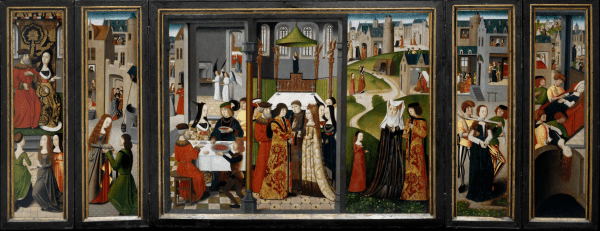
One of the female saints who was venerated during the late eleventh century was Godelieve of Gisel. The life of Godelieve of Gisel reflects the way women were valued during the medieval period. Godelieve’s vita was written by Drogo of Sint-Winoksbergen at the end of the eleventh century, about ten years after her death. This vita aided in the process of veneration or canonization, as it described Godelieve’s life and the events that took place that made her worthy of sanctity. What makes Godelieve unique is that she is the only married female martyr to be canonized as a saint by a medieval pope.
I have struggled to find details about Godelieve’s life, other than in the works have been cited at the end. The Vita Godeliph written by Drogo is hard to access and so I have made do with the information I have found. Godelieve’s story is one of abuse and murder, but also one of miracles. Godelieve of Gisel was born sometime between the year 1040 and 1050 at Londesvoorde Castle in France. Godelieve was a a very beautiful young woman and was sought after by many suitors, however, she was also very pious and faithful to God. The Count of Bourgogne who was the ruler in that region arranged her marriage to Bertolf of Gistel against her wishes. Godelieve was most likely married when she was quite young, by modern standards. Bertolf and Godelieve’s marriage was an unhappy one.
Soon after they were married, Bertolf punished her by ordering his servants to only allow her to eat bread and water. Godelieve demonstrated her kindness by sharing her meager meals with the poor. Drogo wrote in her vita that Bertolf was a cruel and abusive husband and even possessed by the devil; inflicting abuse on Godelieve, possibly blaming her for his own sexual dysfunction. Eventually Godelieve escaped and ran back to the home of her father, Hemfrid. However, Hemfrid feared for his daughter’s future and took her back to Bertolf to continue to act as his wife. Unfortunately, Hemfrid’s fears were not unfounded but were also misplaced. When Godelieve returned, Bertolf ordered two of his servants to murder her and she was strangled in her bed and then thrown into a pool of water to make it look as if she was drowned.
Saint Guinefort is another unique saint for the medieval period and for the Catholic Church in general. In 1260, the Catholic Church heard of miracles being performed by a Saint Guinefort in southeastern France. Saint Guinefort was supposedly healing sick children and was being worshipped by the local women. The papacy decided to send the Dominican Inquisitor Stephan of Bourbon to investigate the holy man. However, when Stephan arrived he found that the followers of Saint Guinefort were not worshipping a holy man but a greyhound.
Guinefort was a greyhound who was owned by a knight who lived in Lyon. According to Stephan’s report to church,
“In the diocese of Lyons, near the enclosed nuns’ village called Neuville, on the estate of the Lord of Villars, was a castle, the lord of which and his wife had a baby boy. One day, when the lord and lady had gone out of the house, and the nurse had done likewise, leaving the baby alone in the cradle, a huge serpent entered the house and approached the baby’s cradle. Seeing this, the greyhound, which had remained behind, chased the serpent and, attacking it beneath the cradle, upset the cradle and bit the serpent all over, which defended itself, biting the dog equally severely. Finally, the dog killed it and threw it well away from the cradle. The cradle, the floor, the dog’s mouth and head were all drenched in the serpent’s blood. Although badly hurt by the serpent, the dog remained on guard beside the cradle. When the nurse came back and saw all this she thought that the dog had devoured the child, and let out a scream of misery. Hearing it the child’s mother also ran up, looked, thought the same thing and screamed too. Likewise the knight, when he arrived, thought the same thing and drew his sword and killed the dog. Then, when they went closer to the baby they found it safe and sound, sleeping peacefully. Casting around for some explanation, they discovered the serpent, torn to pieces by the dog’s bites, and now dead. Realising then the true facts of the matter, and deeply regretting having unjustly killed so useful a dog they threw it into a well in front of the manor door, threw a great pile of stones on top of it, and planted trees beside it, in memory of the event.”
This well became a sort of shrine for Saint Guinefort, the holy greyhound. When women would go to the shrine with their sick children they would, supposedly, be miraculously healed.
When Stephan of Bourbon realized that Saint Guinefort was a dog, he reported back to the Catholic Church, who then required him to destroy the shrine and stop the local people from worshipping him. Stephan disinterred Saint Guinefort’s remains and had them destroyed. He then burned down the trees that surrounding the well that made up the shrine.
While Stephan of Bourbon can be seen almost as a villain in this story, his report to the church shows that he was very sympathetic to the plight of the holy dog stating that Guinefort’s death was a “unjustly killing of dog so useful” and that it was a “noble deed and innocent death.” Stephan of Bourbon’s report back to the church, which was describing how he destroyed the shrine and cult of saints, was what made it so Saint Guinefort survived throughout history and is still known today as the holy greyhound.
Bibliography
Stephen of Bourbon (Etienne de Bourbon), “De Superticione” in “De septem donis Spiritus Sancti”, or “Tractatus de Diversis Materiis Praedicalibus”, in Anecdotes Historiques, Legends et Apologues Tires de Receuil inedit d’Etienne de Bourbon, ed. Albert Lecoy de La Marche (Paris: La Société de l’Histoire de France, 1877), pp.314-29.
Goodish, Michael. “The Politics of Canonization in the thirteenth century: lay and Mendicant saints.” Saints and their Cults: Studies in Religious Sociology, Folklore and History. Pg. 169-187.
Klaniczay, Gábor. ‘The Power of the Saints and the Authority of the Popes. The History of Sainthood and Late Medieval Canonization Processes’, in Church and Belief in the Middle Ages: Popes, Saints, and Crusaders (Amsterdam, 2016).
Kienzle, Beverly Mayne and Nancy Nienhuis. “Battered Women and the Construction of Sanctity,” Journal of Feminist Studies in Religion 17, 1 (Spring 2001): 33-61.
Rist, Rebecca. “The papacy, Inquisition and Saint Guinefort the Holy Greyhound.” Reinardus. Yearbook of the International Reynard Society 30, no. 1 (2018): 190-211.
Salih, Sarah. “Saints and sanctity in medieval England.” British Library. Jan. 2018.
Venarde, Bruce. “Drogo of Sint-Winoksbergen, Life of St. Godelieve,” Medieval Hagiography. (Jan. 2018).


 Medieval Murder