Book Review: The Shardlake Series by C.J. Sansom

The Shardlake Series was written by C.J. Sansom over the course of almost twenty years. The first novel, Dissolution, was published in 2003 and the last book in the series, Tombland, came out in 2019. The series follow the main character, Matthew Shardlake, a lawyer practicing in London during the time of King Henry VIII and Edward VI. Each of the novels follows Shardlake as he pursues a different murder mystery in London and across England. Throughout each adventure, historical and political events impact Shardlake and his assistants from the dissolution of monasteries to the rebel uprising of Robert Kett. Fans of Susanna Gregory and S.D. Sykes will love this Tudor murder mystery series. 

While originally picking up this book in the airport in Edinburgh because I’d had my eyes on it for the last five years and I needed something to read on the plane, I ended up falling in love with this series and have spent the last three months devouring them! This series is exceptionally well written and truly pulls you into the atmosphere of Tudor England. Small warning: the murders get progressively more gruesome throughout the series.

Rating: 4.5/5.0

Book Review: The Burning Girls by C.J. Tudor

If you’re looking for a witchy, thriller, perfect for an October night, definitely pick up The Burning Girls by C.J. Tudor. Tudor creates the perfect atmospheric, psychological thriller set in a small English village. While I don’t usually enjoy books with dual perspectives, the mother-daughter dual perspective in this novel works perfectly. The story line follows Reverend Jack Brooks and her daughter Flo, who move to the small village, Chapel Croft, after the mysterious death of the village’s previous Reverend. As the pair get acclimated to their new home, they discover the village’s pained past that includes missing girls, ghostly apparitions, and a history of witchcraft. Beautifully written and poignant, C.J. Tudor’s The Burning Girls is a must read, especially since it will soon be turned into a television series!

Rating: 5.0/5.0

The Execution of Ælfheah of Canterbury

Ælfheah was born in 954 in either Gloucestershire or Somerset, England. It is thought that Ælfheah was born into Anglo-Saxon nobility. Early in his life Ælfheah entered the Benedictine Monastery of Deerhurst in Gloucestershire as a monk, but shortly thereafter he transferred to Bath Abbey where he became an anchorite. As an anchorite, Ælfheah would have entered into a strict religious life in which he would take last rites and then be enclosed into a solitary room. This room would often be attached to the parish church with a small window allowing for a servant or another monk to bring food and water to him. During his time as an anchorite, Ælfheah would have devoted his time to prayer and meditation. 

It is unknown how long Ælfheah led his life as an anchorite before he was actually promoted within Bath Abbey to an Episcopate. He was then elected as Abbot of Bath Abbey sometime in the late 970s or early 980s and appointed by the Archbishop of Canterbury, Dunstan. During his time as abbot, Ælfheah enacted stricter rules for the monks within the abbey; making sure that they followed the Rule of Saint Benedict which was written 400 years prior. These rules included a structure for the Benedictine way of life in a monastery with special attention paid to obedience, the role of the abbot, silence, humility, and even sleep, among others. 

During this early period of Ælfheah’s appointment as Abbot of Bath Abbey, a new king came to power in England, Æthelred the Unready. Æthelred became king in 978 at only 10 years old after the death of his father, Edward the Martyr. During his reign, Æthelred the Unready dealt with several threats to the English kingdom including a war with the Danes which would last several decades and an increase in viking invasions throughout the 980s and 990s. 

In 984, Ælfheah was appointed as the Bishop of Winchester by Archbishop Dunstan, who had now become one of the young king’s key advisors and counselors. During his time as the Bishop of Winchester, Ælfheah oversaw the construction of a large organ within the cathedral which supposedly could be heard up to a mile away and was so large that it took over twenty men to play it. Unfortunately, the organ does not survive today. Ælfheah also expanded the churches within his district and promoted the cult of Saint Swithin, who had been the Bishop of Winchester over a century before. 

During the 980s and 990s, new viking invasions began in England. However, in 991 the young King Æthelred agreed to pay a sum to the viking invaders in order for the invasions to stop. This was only successful for a short amount of time as invasions resumed again just three years later. One of Ælfheah’s most notable, and later relevant, accomplishments during his bishopric was the negotiation of a peace treaty with the vikings after a majorly damaging viking invasion in 994 in which they attempted to burn the city of London to the ground, luckily unsuccessfully. The viking King of Norway at this time was Olaf Tryggvason who actually participated in the raid of 994. It is thought that after this raid, as one of the most notable religious figures in England at the time, Ælfheah provided guidance to King Æthelred in regard to a peace treaty with the vikings, more specifically with Olaf Tryggvason. 

After the peace treaty, it is thought that Olaf Tryggvason, King of Norway, actually converted to, or at least confirmed, his belief in Christianity with the aid of Ælfheah’s influence. When he returned to Norway, he began to impose Christianity on the areas under his control in Norway, largely communities along the coast. It is also thought that Olaf took Christianity via missionaries to the Shetland, Faroe, and Orkney islands, as well as to Iceland and Greenland. While Olaf did seem to stick to his word in terms of not raiding England after the peace treaty, other vikings did continue to invade. 

In 1006, Ælfheah was promoted to be Archbishop of Canterbury. The following year he journeyed to Rome in order to meet with the pope, at the time Pope John XVIII. During Ælfheah’s journey, he was actually robbed by a gang of highwaymen but luckily escaped with his life. 

While Ælfheah did several notable things during his tenure as Archbishop of Canterbury, this blog is dedicated to Medieval Murder and so we will skip these things and move on to his death just four years later in 1011. In around 1011, the viking raiders largely made up of Danish and Swedish vikings invaded England led by Thorkell the Tall. However, this time they focused their attack on Canterbury after having successfully sacked many English cities up the coast. The raiders were described as “an immense raiding army” by the Anglo-Saxon Chronicle and was made up of men who were coming from a career of violence and robbery. The invasion lasted almost a month as they laid siege to Canterbury from around the 3rd to the 29th of September 1011. 

Unfortunately, after a stong defense by the citizens of Canterbury, the city was sacked by the vikings. According to the Anglo-Saxon Chronicle “In this year, between the Nativity of St. Mary and Michaelmas, they beset Canterbury, and entered therein through treachery; for Elfmar delivered the city to them, whose life Archbishop Elfeah formerly saved.” Once the vikings entered the city they “seized Archbishop Elfeah, and Elfward the king’s steward, and Abbess Leofruna, and Bishop Godwin; and Abbot Elfmar they suffered to go away. And they took therein all the men, and husbands, and wives; and it was impossible for any man to say how many they were; and in the city they continued afterwards as long as they would. And, when they had surveyed all the city, they then returned to their ships, and led the archbishop with them.” Once they had captured everyone who they deemed of importance and plundered everything of value, the vikings burned Canterbury Cathedral. 

Ælfheah was kept hostage by the vikings for seven months during which time he refused to allow a ransom be paid for his release. As the Anglo-Saxon Chronicle states 

“Then on the Saturday was the army much stirred against the bishop; because he would not promise them any fee, and forbade that any man should give anything for him. They were also much drunken; for there was wine brought them from the south. Then took they the bishop, and led him to their hustings, on the eve of the Sunday after Easter, which was the thirteenth before the calends of May; and there they then shamefully killed him. They overwhelmed him with bones and horns of oxen; and one of them smote him with an axe-iron on the head; so that he sunk downwards with the blow; and his holy blood fell on the earth, whilst his sacred soul was sent to the realm of God.” 

“The corpse in the morning was carried to London; and the bishops, Ednoth and Elfhun, and the citizens, received him with all honour, and buried him in St. Paul’s minster; where God now showeth this holy martyr’s miracles. When the tribute was paid, and the peace-oaths were sworn, then dispersed the army as widely as it was before collected. Then submitted to the king five and forty of the ships of the enemy; and promised him, that they would defend this land, and he should feed and clothe them.” 

Ælfheah was the first Archbishop of Canterbury to be murdered. The leader of the viking raiders that killed Ælfheah, Thorkell the Tall, supposedly attempted to stop the angry mob from killing Ælfheah. He was so disgusted and appalled that they would kill the Archbishop that he then joined forces with King Æthelred. 

Ælfheah of Canterbury was venerated as a saint fifty years later and is now known as Saint Ælfheah of Canterbury, one of the martyred saints.

Bibliography

The Anglo-Saxon Chronicle

“About Anchorites.” Hermits and Anchorites of England. University of Exeter. 2010. http://hermits.ex.ac.uk/index/anchorites 

Cavendish, Richard. “Archbishop Aelfheah of Canterbury Murdered by Vikings.” History Today 62, no. 4 (2012): 9.

The Rule of Saint Benedict. Translated by Leonard Joseph Doyle. United States: Liturgical Press, 2001.

“Olaf Tryggvason.” Britannica. https://www.britannica.com/biography/Olaf-Tryggvason Williams, Ann. Æthelred the Unready: the ill-counselled king. United Kingdom: Bloomsbury Academic, 2003.

Book Review: The House Between Tides by Sarah Maine

Sarah Maine’s debut novel The House Between Tides (2014) is a beautiful examination of relationships, grief, and the impact of emotions on those around us. Set on an isolated island in the Outer Hebrides of Scotland, The House Between Tides is dual point of view novel, from the point of view of Hetty, a woman who inherits Muirlan House from her grandmother, and Beatrice, the wife of renowned painter, Theodore Blake, who lived on the island during the early 1900s. When Hetty arrives on the island to examine the house she finds out that the bones of a murder victim have been found under the floorboards and she spends the rest of the novel researching the history of the house and trying to come to terms with what she wants. While Hetty is researching the house, we are seeing the history of the house unfold from Beatrice’s perspective. 

While it took me a while to fully get into this novel, I ended up falling in love with it. Both points of view were interesting and drew me in. I found myself guessing throughout the story who the bones would be and I kept changing my mind. Sarah Maine has created a dark and brooding mystery and a wonderful story of ancestral history and how grief affects us. I highly recommend this book.

Rating: 5.0/5.0

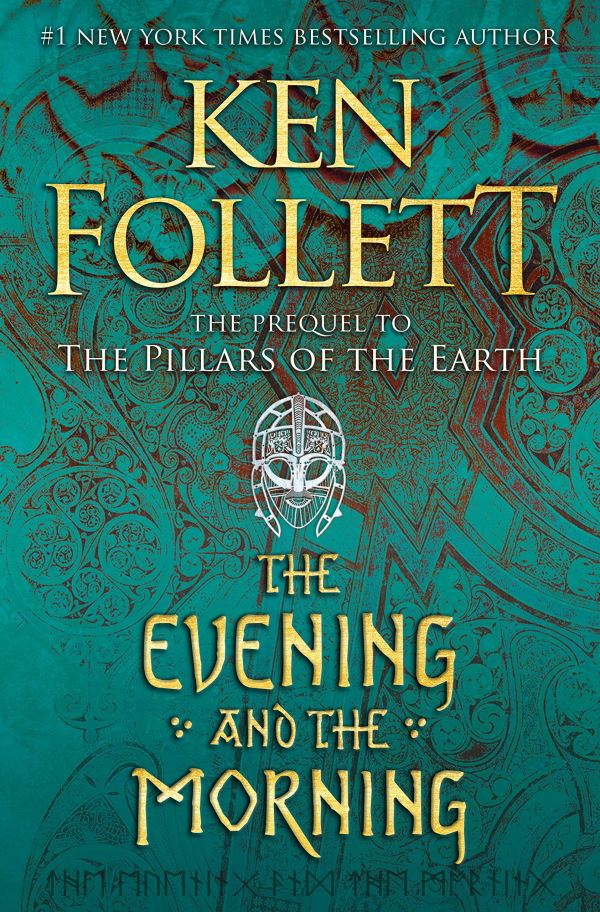
Book Review: The Evening and the Morning by Ken Follett

The prequel to Ken Follett’s award winning Knightsbridge Trilogy The Evening and the Morning begins at the end of the 10th century in England, with excursions to the Norman coast. While written thirty years after the first novel in the trilogy, Pillars of the Earth, and set almost 150 years prior, The Evening and the Morning still provides the same engrossing storytelling and historical setting that will please original fans of the Knightsbridge Trilogy and newcomers alike. 

Ken Follett’s The Evening and the Morning is filled with a compelling story-line (especially for fans of evil plots, religious turmoil, and, of course, murder), complex characters that you’ll both love and hate, relationships that will draw on your heartstrings, and action and adventure. Even though it’s quite large, I couldn’t put it down so it was a relatively quick read. I won’t give everything away but I highly recommend this novel to anyone who loves to read and wants to fully be immersed in another place and time. 

Rating 5.0/5.0

The Mystery of the Princes in the Tower

Edward IV became the King of England on March 4th, 1461 and was a member of the House of York. In 1464, he married Elizabeth Widville in a secret ceremony. Six years later, in November of 1470, Edward V was born as heir to the English throne. At the time that Edward was born, his father, was actually in exile in the “Low Countries” as Henry VI, a member of the house of Lancaster, had briefly been proclaimed King of England. However, Edward IV returned home in 1471 and reclaimed the English crown and named his son Edward Prince of Wales.

Because his father was in exile, Edward V was actually born in Westminster Abbey as his mother had sought sanctuary there. Three years later in August of 1473, his brother, Richard of Shrewsbury was born, and surprisingly his father did not have him named a prince but as a Duke of York. 

The two brothers were not raised together, as Edward V was given his own household as a prince at Ludlow Castle in what is now Shropshire, England. Richard of Shrewbury was raised separately, possibly with his five sisters. 

Edward V was only twelve when news reached him of his fathers death on the 14th of April, 1483. It is not known what King Edward IV died of but theories include pneumonia, malaria, apoplexy or even poisoning. After his fathers death, Edward V was assumed as King of England. Located at Ludlow Castle, Edward V did not immediately set out to London as his mother, Elizabeth Widville, was there to take power for him and to begin the planning for his coronation. It wasn’t until April 14th that Edward V, along with his uncle, the Early Rivers set off for London. 

It is important to note that Elizabeth Widville did not notify her husband brother, Richard of Gloucester, of the king’s death. Instead, he found out about it from another party. Once he had heard of it, however, Richard of Gloucester set out to meet Edward V and ride in with him to London in order to support his transition over to king. So on Wednesday April 30th, Richard of Gloucester met Edward V at Stony Stratford, just north of London, and took guardianship of him.

When the entourage arrived in London, Edward V was established as the new King of England and his uncle, Richard of Gloucester was made the lord protector of the kingdom, as Edward was still so young. This was a disappointment to his mother who had been attempting to set herself up as the Regent for her young son, a tradition that was common in France, but not England at the time. And so, Elizabeth Widville sought sanctuary again in Westminster Abbey with her daughters and her son, Richard of Shrewbury.

When he arrived in London, the young king took up residence at the Tower of London, which was not only a prison but a royal castle. However, Richard of Gloucester did not stay with him at the Tower but at his mother’s residence elsewhere in London. In order to provide some company to the young king, Richard of Gloucester sent a delegation to Westminster Abbey to convince Elizabeth Widville to send the king’s brother, Richard of Shrewsbury, out of sanctuary to join his brother at the Tower. Eventually she complied and Richard of Shrewsbury joined Edward V at the Tower.

Originally, Edward’s coronation was set for May 4th, but Richard of Gloucester rearranged for it to be on June 24th so that the new king could open parliament on the following day. During one of the planning meetings at a royal council meeting held on June 9th, Bishop Stillington of Bath and Wells decided to address the royal council and claimed that Edward V could not be crowned as the King of England. Year earlier, before his marriage to Elizabeth Widville, King Edward IV has also been secretly married to a woman named Eleanor Talbot, a marriage that was supposedly performed by Bishop Stillington himself. Eleanor Talbot had also still been alive during Edward IV’s second marriage, thus making his marriage to Elizabeth illegitimate and all of his children bastards. This meant that Edward V had no rightful claim to the throne. 

An unofficial parliament held that week declared that all of Edward IV’s and Elizabeth Widville’s children were illegitimate. After this was established, five days later Edward V’s uncle and protector of the realm, Richard of Gloucester was persuaded to become King of England.

On June 22nd, in order to make Richard III’s coronation more acceptable sermons were given out at Paul’s Cross and throughout London which raised publicly the issue of the bastardy of Edward V and his siblings. They also put forward what the Bible said should be done in respect of bastardy. On June 26th he was crowned King Richard III.

After Richard III’s coronation, supposedly a secret meeting was held between the Dukes of Hastings, Rotherham and Morton in which they discussed their disapproval of the removal of Edward V. Later at a parliament meeting, Lord Hasting’s supposedly attempted to attack Richard III (more likely he told him of his disapproval with hostility) and then: “The protector (Richard) cried out that a plot had been prepared against him, and they had come with concealed weapons, so that they could make the first attack. Then soldiers who had been stationed there by the lord, and the Duke of Buckingham, came running, and beheaded Hastings by sword under the name of treason.” The other two conspirators were imprisoned in Welsh castles. 

A few weeks later, a supposed coup was being formed by the Duke of Buckingham. According to an early sixteenth century account called the Divisikroniek, “the Duke of Buckingham killed these children hoping to become king himself and this for the reason that he had read a prophecy about a future King Henry of England who would be very great and powerful, and he believed himself to be this for he was called Henry. And some say also that this Henry Early of Buckingham killed only one child and spared the other which he then lifted from the front and had him secretly abducted out of the country.” However, this was never proven. 

Richard III, heard of the coup being planned and had the Duke of Buckingham captured and executed. 

The fate of the two brothers, Edward V and Richard of Shrewsbury remains unknown, but it does appear that at least Edward V did die in the late summer of 1483, because after that date there is no documentation that he was ever seen again but there is also no documentation that he was ever put to death. Several documents do seem to point toward his death as he is referred to as the “late king” and as the “late son of Edward IV.” It is very possible that he died of illness as his doctor had been visiting the Tower to see him frequently. However, Richard of Shrewsbury seemed as healthy as a horse and was documented several times at being a gleeful boy.

There were also supposed plots and attempts to kidnap the boys from the Tower. Specifically, supposedly four men tried to abduct the two brothers from the tower by igniting diversionary fires around the Tower. However, they were captured and were tried at Westminster, condemned to death, drawn to Tower Hill and beheaded, and their heads were exhibited on London Bridge. No one knows why they were trying to get the boys, if they were, possibly for political reasons. 

In 1485, King Richard III was killed at the Battle of Bosworth, afterwhich Henry VII of the House of Lancaster, eventually the House of Tudor, usurped the throne, which completely changed the political situation in England.

As soon as he had been crowned King of England, Henry VII imprisoned Bishop Stillington who had announced to the royal council that Edward IV had secretly married Eleanor so his marriage to Elizabeth was illegitimate. This was because Henry’s claim to the throne was weak and in order to strengthen it he wanted to erase the ruling that Edward IV’s children were illegitimate and marry Edward IV’s oldest daughter who would then again be the heiress of the House of York. This was accomplished when his first act of parliament was to destroy the act of parliament that declared them illegitimate. 

However, this also meant that if either Edward V or Richard of Shrewbury was still alive they had an even better claim to the throne, meaning that Henry VII had an even better motive for killing the boys than anyone else. But, there is do evidence that they were alive then, or that he had them killed. In order to further the possibility that the boys were dead, from 1502 onward the official version of their life story stated clearly that both Edward V and Richard of Shrewbury were deceased, having been murdered nineteen years earlier, in 1483.

The Great Chronicle of London, which seems to have been completed in about 1512 cites three different rumours to the effect that the two boys may have been smothered in their feather beds, or possibly they were drowned in malmsey wine, or maybe they were poisoned.

The version of the story that has been the most upheld, but is likely the least factual, was written by Thomas More who was actually only five years old when the events actually occurred. He claims that: “Sir James Tyrell devised that they should be murdered in their beds, to the execution whereof he appointed Miles Forest, one of the four that kept them, a fellow fleshed in murder before time….about midnight came into the chamber and suddenly lapped them up among the clothes – so bewrapped them and entangled them, kepping down by force the featherbed and pillows hard unto their mouths, that within a while, smores and stifled, their breath failing, they have up to God their innocent souls into the joys of heaven, leaving to the tormentors their bodies dead in the bed.”

Nearly two hundred years after the boys disappearance, the bones of two children were found underneath a set of stairs in the Tower of London. Believing that they were bones of the two lost princes they were place in an urn and interred in Westminster Abbey. However, no one knows for sure if those are the boys bones or even if they were murdered.

Bibliography

Ashdown-Hill, John. The Mythology of the ‘Princes in the Tower’. United Kingdom: Amberley Publishing, 2018.
Thornton, Tim. “More on a Murder: The Deaths of the ‘Princes in the Tower’, and Historiographical Implications for the Regimes of Henry VII and Henry VIII.” History 106, no. 369 (2021): 4-25.

Book Review: A Shameful Murder by Cora Harrison

A Shameful Murder was written by Cora Harrison and published by Seven House Publishers in 2015. The first in the Reverend Mother Mystery series, A Shameful Murder takes place in Cork, Ireland in the 1920s. The novel opens with the Reverend Mother finding the body of young girl who has washed into the street by the convent due to the flooding in Cork. The Reverend Mother takes a special interest in the girl, deducing, with the help of Police Sergeant Patrick Cashman and Dr. Sher, that the young girl has been murdered. The three of them begin to investigate the murder of the girl and look into her family, the upperclass of Cork, and even the local asylum. Fans of Arthur Conan Doyle and Tana French will love this 1920s murder mystery. 

While originally picking up this book because I did not realize it was set in the 1920s and thought it was set during the medieval period, I enjoyed it from beginning to end! I’m excited to read further in the series and find out what other mysteries the three eccentric characters will investigate! This novel is exceptionally well written and will leave you thinking that you really are experiencing Cork. Fans of Arthur Conan Doyle and Tana French will love this 1920s murder mystery. 

Rating: 5.0/5.0

Book Review: The Maidens by Alex Michaelides

The Maidens was released in June 2021 as Alex Michaelides second novel after his New York Times bestselling novel The Silent Patient. I initially picked this book up in airport and the description pulled me in. It seemed to have everything I was looking for: dark academia, murder, intrigue, the lot. 

The Maidens begins with an introduction to the main character, Mariana Andros, and her role as a group therapist. While I did like this as a concept, in practice it didn’t seem to play out as well as I had hoped. Throughout the book, the author refers back to her role as a group therapist but it never fully seemed necessary or relevant for such a large emphasis. The novel looks at the murder of several girls at Cambridge University and how Mariana tries to solve the murders. The girls are friends of Mariana’s niece and the most likely suspect is their classics professor, Edward Fosca.

The plot was interesting and it was quite easy to engage with the story. However, there were several plot holes, and there wasn’t as much of an emphasis on classics and the academia part of “dark academia.” The ending was not what I was expecting as it seemed like the author was leading the story in another direction until the last couple of chapters. 

Rating: 3/5

Medieval Serial Killer or Werewolf?

In the present day, in general, society looks back at the Middle Ages and sees things like a belief in witchcraft, werewolves, and even sea monsters as confusing and even childish. How could they have truly believed in any of this? That is what this blog post will be discussing; the truth behind the legends. 

In the thirteenth and fourteenth centuries, Christianity had brought forth a more widespread belief in God and the devil. Medieval authorities were still executing people for witchcraft, but a different form of the witchcraft than we think of today. Instead of flying broomsticks, the witchcraft of the Middle Ages was causing harm through occult means. This was known as maleficium in Latin which translates today to “mischief.” So authorities were persecuting individuals for their crimes of maleficum; not necessarily because they thought they were our stereotypical version of witches. 

The concept of a werewolf was thought of in a similar fashion as they were being influenced by Satan to commit wrongdoings. However, throughout the Middle Ages many, including priests, physicians and monks, believed that lycanthropy (becoming a werewolf) was actually a form of madness or mental illness. Paul of Aegina, a Byzantine physician, wrote:

“Those suffering from lycanthropy go out during the night imitating wolves in all things, and lingering about tombs until morning. You may recognize these person by these marks; they are pale, their vision feeble, their eyes dry, tongue very dry and the flow of the saliva stopped; but they are thirsty, and their legs have incurable ulcerations from frequent falls. Such are the symptoms of the disease. You must know that lycanthropy is a species of melancholy.”

Between 1450 and 1650, there was a sort of werewolf “epidemic” in Europe, similar to the witch hunts of the same period, although on a much smaller scale. During this period there were at least 300 werewolf trials throughout Western Europe (compared to the tens of thousands of witch trials), most of them located in France and Germany, that can be argued to have truly just been trials of medieval and early modern serial killers. Here are some of the stories of serial killer werewolves.

In the late sixteenth century, Peter Stubbe was a resident of Bedburg, Germany. Peter was a friendly face within the community and would check in with his neighbors and friends on a  regular basis. While reports from after his arrest point to him being greatly inclined to evil throughout his youth and that he had given both his soul and body to the Devil, this was most likely untrue as he had been an upstanding member of society (or so they thought). In 1589, Stubbe was accused of making a deal with the devil to transform himself into a werewolf. In truth, Stubbe was arrested for the rape, murder and cannibalization of eighteen victims, including two pregnant women. 

The sixteenth century report of Stubbe’s crimes claims that through his pact with the devil he was given a magic belt that would transform into a werewolf so he could more easily murder and eat his victims. Stubbe was seen escaping from his last murder by two hunters, who apparently saw him in his human form because he had slipped the belt off during his attempted escape. Stubbe was apprehended by the hunters and taken to the town magistrates.

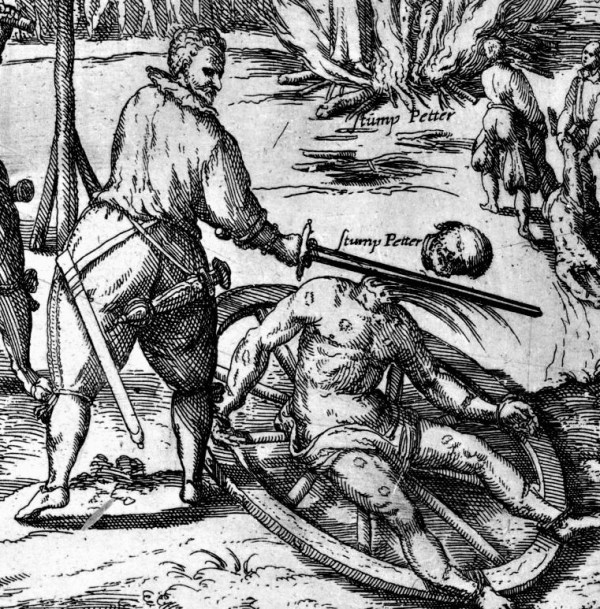
On October 18, 1589, Peter Stubbe was executed. His body was laid on a breaking wheel and in ten places his flesh was pulled from his bones with red hot metal pinchers. His arms and legs were then broken with a hatchet and his head was struck from his body. They then burned his body. 

A little over sixty years earlier, in France, two men were also accused of being werewolves. Pierre Bourgot and Michel Verdung were known as the Werewolves of Poligny. It was claimed that they had also made a deal with the Devil so that they could transform into werewolves and indulge in their homicidal tendencies. Supposedly, the pair killed a woman who was in her garden, a four year old girl who they later ate, and two other young girls whose blood they drank. Both men were arrested and executed in 1521 for their crimes. 

Another man, Jacques Roulet, was arrested after murdering and cannibalizing a fifteen year old boy outside of Angers, France. Unlike the previous werewolf stories, during his trial Roulet claimed he used a magical ointment to transform into the murderous beast. He also confessed to the murder of several children and adults. Roulet was originally sentenced to death but in 1599 he pleaded insanity, which was accepted by the French parliament.

A more well-known story of a “werewolf” was the Beast of Gevaudan. This happened much later in history, after the medieval period, between 1765 and 1767. Gevaudan was a rural region in the South of France. What makes this story stand out from the others, however, was that the best may actually have been a wolf, not a man. In May of 1764, the Beast of Gevaudan made his attack on a young girl tending to a herd of cattle. The girl was unhurt, but described the beast as “like a wold, yet not a wolf.” On June 30th, just a month later, the beast committed his first fatal attack on a fourteen year-old sheep shepherdess. 

Throughout the rest of that summer the beast attacked and ate many young women, and a few young adult men. Many hunters attempted to catch the beast but to no avail. In January of 1765, a young boy, Jacques Portefaix was attacked by the wolf-like beast but he and his friends fought it off until it retreated back into the forest. King Louis XV heard of the boys bravery and rewarded him with a funded education. The King then sent hunters into the woods to catch and kill the beast.

In the late summer of 1765, a large wolf was shot and killed in the Gevaudan region that was believed to be the beast. The wolf was stuffed and sent to royal court in celebration. However, not long after, the attacks started again. The attacks continued throughout the year until the next summer when another wolf was shot and killed. This time human remains were found inside the wolf and the animal had non-wolf like features as his first victim had described. After it’s death the attacks stops, but no one knows whether it was truly a wolf or a werewolf.

Historians have argued that the beast may have been a Eurasian wolf, a dog wolf hybrid, a hyena, and even a lion. Others have argued that it was actually a serial killer, not an animal at all, that committed the attacks as most of its victims were decapitated. Unfortunately, we will never know. 

Bibliography

Schulte R. (2009) “The Persecution of Men as Werewolves in Burgundy.”  Man as Witch. Palgrave Historical Studies in Witchcraft and Magic. Palgrave Macmillan, London.

https://www.history.com/news/beast-gevaudan-france-theories


Vronsky, Peter. Sons of Cain: A History of Serial Killers from the Stone Age to the Present. United States: Penguin Publishing Group, 2018.

Gilles de Rais: A Medieval Serial Killer

The late medieval period saw the death of thousands of people through plague, famine, and war; and while this period also saw an expansion in trade and commerce, and philosophy, science and the arts, I would like to focus on a byproduct of these tragedies: Gilles de Rais. 

Gilles de Rais was born sometime in the early 1400s in Champtocé-sur-Loire, France. He was born into a life of feudal lordship, a life of education and of wealth. Both of his parents died when he was just a child and at the age of eleven he was taken in by his grandfather Jean de Craon, one of the richest lords in the Anjou valley. Jean de Craon was a greedy and cruel man who taught his grandson to be the same. For example, when Gilles was just sixteen years old, his grandfather took two young women captive. He threatened to sew the older, Beatrice, into a sack and have her thrown into the river to drown. The two girls were put up for ransom and when three soldiers came to claim them, they were also imprisoned by Craon’s soldiers and thrown into a deep pit where one dies. Eventually the elder sister was released once the ransom had been paid, while the younger sister was forced to marry on of Craon’s soldiers. Gilles witnessed and took part in all of this cruelty, along with many more throughout his childhood with his grandfather.

Gilles de Rais’ grandfather also left him with a lot of time to himself at a young age. So not only was he witnessing cruelty and even murder, he was also not being raised in a family setting. Shortly after the kidnapping of the two sisters, Craon successfully arranged that Gilles de Rais marry Catherine de Thouars of Brittany who was a very wealthy heiress. They had a daughter, Marie in 1434. 

When Gilles was in his early twenties he was made leader of an Angevin army during the Hundred Years’ War. It was at this time that he met Joan of Arc, who requested he fight in her regiment due to the way he fought with fury and bloodlust. His success in the battle lead him to receive the highest military honor in France; the Marshal of France. Soon after Gilles became Marshal, the power went to his head and he began spending his inheritance recklessly and living in extravagance. His grandfather, Jean de Craon, was so disappointed that when he died he left his sword to not Gilles, but his younger brother, Rene. 

This slight seems to have resonated with Gilles. After he retired from the military in 1435, he began to put more significance in religion and in trying to save his dwindling fortune. He funded the construction of a private church, which he named the Chapel of Holy Innocents. This chapel became home to a choir of young boys from the local area, all of whom were hand selected by Gilles himself.  It was at this same time that he began to toy with occult; searching for men who could practice alchemy and demon summoning for him. It is thought this was to save his fortune; but a darker truth would come to light later. 

While Gilles had attempted to disappear from public life after he retired from the military, rumors were circulating about him throughout France. Young boys had been going missing around Gilles castles and the locals believed he and his servants were involved. The disappearances began in the early 1430s. It wasn’t until 1440, however, that people came forward, claiming to have seen Gilles’ servants disposing of the bodies of young children. Gilles de Rais was arrested in September of 1440 for an unrelated kidnapping of a priest. 

Gilles was tried for heresy, sodomy, and murder. Under threat of torture, and possibly due to a guilt, Gilles immediately confessed to all charges. He claimed that the killings began in 1432, the year his grandfather died. He would make his servants kidnap young boys, usually members of the choir, and have them brought back to his castle in Champtocé-sur-Loire. One room was dedicated to torture. It was in this room that Gilles would torture these young boys for hours, with the help of two companions, and then kill them in a variety of ways from blunt force to the head to strangulation to decapitation. After he had killed them, he would drink himself into sleep and his servants would clean the room and dispose of the bodies. 

The parents of the children who had disappeared, witnesses to the servant dumping bodies, and even his accomplices testified against him. During his trial, Gilles himself testified that: 

“…when the said children were dead, he kissed them and those who had the most handsome limbs and heads he held up to admire them, and had their bodies cruelly cut open and took delight at the sight of their inner organs; and very often when the children were dying he sat on their stomachs and took pleasure in seeing them die and laughed.”

While Gilles admitted to the murder of over a hundred boys aged between 6 and 18, it is thought that the number may be closer to two hundred. 

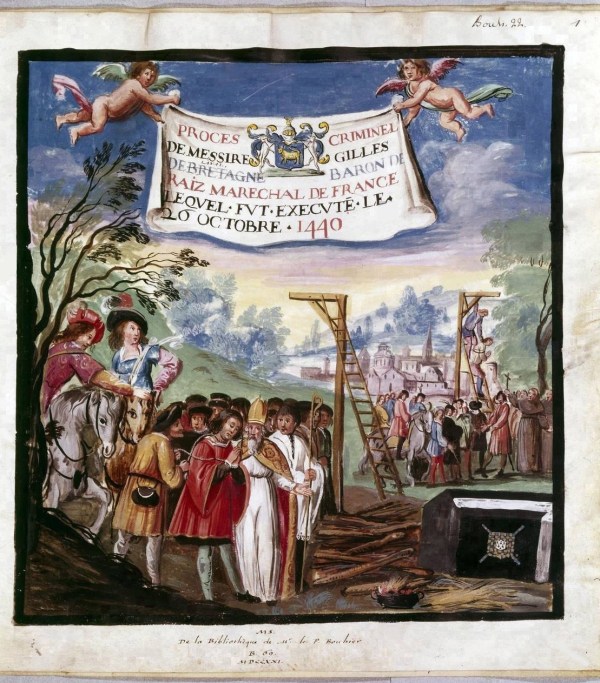
Gilles de Rais was convicted on all charges and sentenced to death. On October 26th, 1440, Gilles de Rais was executed by hanging and burning with tears running down his face in a show of guilt and Christian piety. Gilles accomplices were also executed in the same manner; but Gilles was executed first as he asked not to see them die.

Some historians have argued that Gilles de Rais may not have been guilty of being a serial killer and was set up by either the Catholic Church or the French monarchy, most likely to get his wealth and lands. However, there is no proof of this and due to his confession most historians believe he was guilty.

Bibliography

Bataille, Georges., Rais, Gilles de. The trial of Gilles de Rais. United Kingdom: Amok, 1991.

Benedetti, Jean. The Real Bluebeard: The Life of Gilles de Rais. United Kingdom: Sutton, 2003.

Parsons, Ben. “Sympathy for the Devil: Gilles De Rais and His Modern Apologists.” In Fifteenth-Century Studies 37, edited by Gusick Barbara I. and Heintzelman Matthew Z., 113-38. Rochester, NY; Woodbridge, Suffolk: Boydell & Brewer, 2012.


Penney, James. “Confessions of a Medieval Sodomite.” In Perversion and the Social Relation: Sic IV, edited by Rothenberg Molly Anne, Foster Dennis, and Žižek Slavoj, 126-58. Durham; London: Duke University Press, 2003.

Blog at WordPress.com.

Up ↑