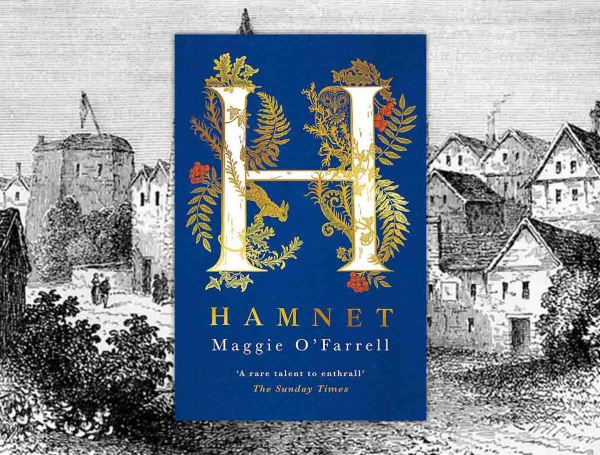
Hamnet came out in 2020 and quickly became an award winning novel by Maggie O’Farrell; and it’s easy to understand why. Hamnet was named the Best Book of 2020 by the Guardian, the Financial Times, Literary Hub, and NPR. Without giving any spoilers, Hamnet follows the life of the children and wife of William Shakespeare during the 16th century and includes a story of how Hamlet came to be; out of plague, out of love and out of grief.
O’Farrell provides a unique perspective on life in the early modern period, and an especially unique perspective on the Shakespeare. The story is told through the eyes of Shakespeares wife, Agnes (otherwise known as Anne Hathaway), and his son Hamnet. While, at first, the switching of viewpoints was a bit frustrating for me, after a few chapters both perspectives really drew me in.
To be honest, I wasn’t expecting the depth present in the novel; I was expecting historical fiction that centered around Shakespeare and his family and his plays. What I got was something even greater. While Hamnet is historical fiction, it is relevant even today. It examines the realities of life, of love and marriage, and of grief. You don’t need to be a lover of Shakespeare, or even historical fiction, to fall in love with Maggie O’Farrell’s Hamnet because it is truly extraordinary and one of the best books as of late. I highly recommend it.
When we had last left Mary Queen of Scots, she was still grieving the assassination of her uncle, the Duke of Guise. However, during 1564 Mary played her part as queen well and began to also “play” politics; both with John Knox and with the Queen of England, Elizabeth I. This mostly centered around Mary’s choice of a husband. Elizabeth had proposed that Lord Dudley (Elizabeth’s supposedly secret lover) was the perfect choice of a husband for her, but Mary had her eyes set on Lord Darnley who gave her a better claim to the English throne.
Henry Stuart, otherwise known as Lord Darnley, was Mary’s distant cousin who also had a claim to the English throne as his mother was the niece of Henry VIII. Darnley met Mary Queen of Scots at Wemyss Castle in Fife, Scotland on February 17th, 1565. Darnley spent the next several weeks constantly in Mary’s company, winning her over with his good looks and charm.
Mary wed Lord Darnley on July 29th, 1565, against the wishes of the English crown. Through their marriage Darnley was made King of Scotland, giving him the same political power as Mary, a natural born queen. At the time of her marriage, Mary seemed very much to enjoy Darnley’s presence and was genuinely attracted to him, thinking she may even have been in love, and felt she had made the appropriate decision in her choice of husband. However, not long after their wedding Darnley began to show his true colors. He began to overindulge in alcohol, he became more arrogant now that he had more political power, and he became aggressive and argumentative with everyone, especially Mary.
The couple’s estrangement was further exacerbated by Mary’s refusal to grant Darnley the crown matrimonial, which would leave him as heir to the Scottish throne if Mary died. Darnley began to work his own political ties with both the Catholics and the Protestants, a move that led to one of the most famous murder plots in the early modern period.
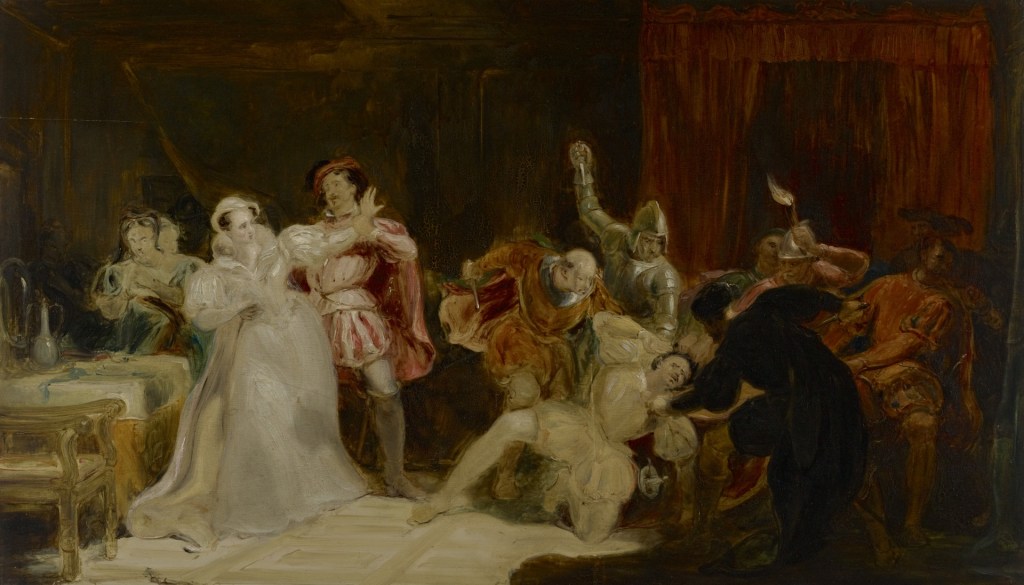
David Rizzio was the private Secretary of Mary Queen of Scots, becoming one of her close personal friends among her Mary’s. However, Rizzio was also relatively close with Darnley, supposedly becoming his lover. Rizzio became collateral damage of Mary and Darnley’s estrangement. Darnley had become convinced that Mary was having an affair with Rizzio, even though he had previously been having an affair of sorts with Rizzio. It was this jealousy that allowed some of the Scottish Lords to push Darnley to murder Rizzio, acquiring his signature on the actual murder plot.
Sir William Allan, 1677. National Galleries of Scotland.
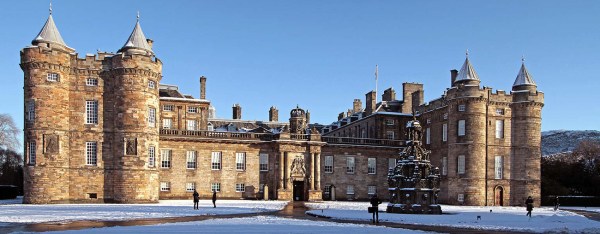
On March 9th, 1566, Darnley let the Lords into the private rooms outside of Mary’s supper chamber in Holyrood Palace where Mary, her ladies, and Rizzio were playing cards. When the Lords burst into the chamber and demanded Rizzio be handed over, Mary knew what they had planned and refused, using her own body to shield Rizzio from their daggers. Unfortunately, Mary was overpowered and threatened with both a gun and a knife and Rizzio was stabbed fifty-seven times. Lord Darnley refused to participate in the actual murder of Rizzio and so one of the Lords took his dagger and used it to stab Rizzio the last time, ensuring that Darnley played a part in the murder.
During this time, Mary was pregnant with Darnley’s child, and the heir to Scotland. While Darnley had agreed to go along with the assassination of Rizzio, Mary convinced him in the days following Rizzio’s death that he should stick by his wife and future child, leading him to escape from Holyrood Palace with her just three days after the murder. Eventually they returned to Edinburgh, but their marriage had disintegrated due to Mary’s understandable distrust of Darnley.
On June 19th, 1566, Mary gave birth to James VI in Edinburgh at Holyrood Palace. The fact that Mary now had a male heir gave her an even greater claim to the English Throne. In the weeks following the birth of her son, Darnley and Mary’s relationship deteriorated even more. The two fought constantly, with Mary even swearing at him in front of her advisors. Mary began to worry that Darnley would kidnap their son to gain more power over her and so moved James to the security of Stirling Castle where she had lived with her mother. Darnley became jealous and suspicious when Mary began to try and make amends with her advisors and lords, believing that she was gathering opponents to him. He began to act even more erratic in front of diplomats and even threatened to separate from Mary and live abroad. This would have put Scotland at risk if Darnley began plotting against Mary without her being able to keep a handle on things. Something had to be done.
Mary saw Darnley as such a risk to her son that she sent a letter to Queen Elizabeth in England requesting that if anything should happen to her that Elizabeth act as her son’s protector. Elizabeth agreed, forming a sort of goodwill between the two queens. Elizabeth then developed a treaty in which Mary would be heir apparent to the English throne if Elizabeth died without heirs.
During these political dealings, the Scottish lords were meeting to discuss what to do about Darnley. He had fulfilled his purpose, giving Mary an heir, and had become volatile and was even a risk to Scotland. What happened to Lord Darnley next has been the subject of much historical debate, as all reports were biased, and there is no way to know the full truth. Mary was asked if she was willing to divorce Darnley, which she was. This was supposedly her only involvement in Darnley’s fate. The Scottish lords convinced Mary to pardon them for their part in the Rizzio murder in order to bring order to the Scottish court, especially as she was also brokering peace between Scotland and England at the same time.
The Scottish lords, specifically Morton, Maitland, and Bothwell, met at Whitingham Castle in East Lothian and formed that assassination plot of Lord Darnley. Mary at this time began to fear again that Darnley was going to kidnap their son, and so she traveled to Glasgow, where he was being treated for syphilis, to bring him back to Edinburgh where she could watch him. Darnley chose to stay in lodgings right outside of Edinburgh to finish his syphilis treatment; believing himself safer than he would be at either Holyrood Palace or Craigmillar Castle.
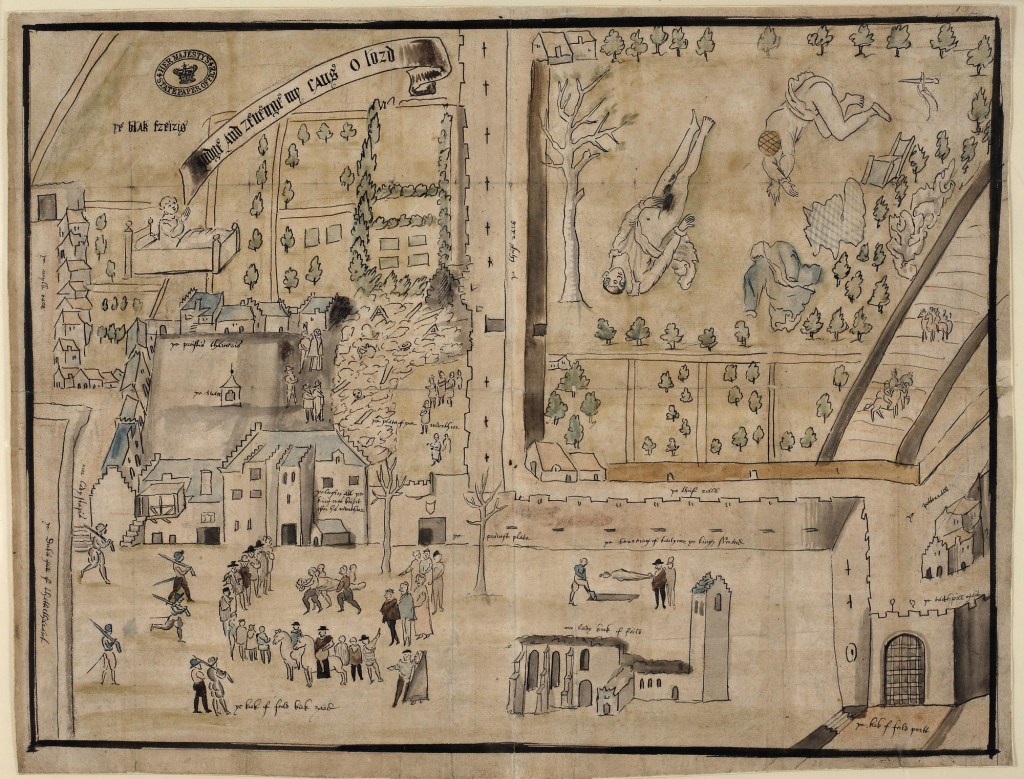
On February 9th, 1567, Mary and Darnley were spending time together at this house, attempting to reconcile. However, while the pair were upstairs, the cellars were being filled with gunpowder by the Scottish lords. Mary left his lodgings at around eleven o’clock that night to go back to Holyrood. It was around two o’clock in the morning when an explosion rocked Edinburgh. Darnley’s lodgings had been destroyed. However, Darnley’s dead body, along with the body of his servant, was found some distance away from the explosion, having survived the blast only to be strangled to death. It is not known who strangled Darnley, but it is thought he must have heard the fuse, realized what was happening and escaped out a window. Whoever strangled him, had done so in the garden before the explosion took place.
Bird’s-eye view of the ‘Kirk o’ Field’, ruined church and churchyard, showing the scene of the murder of Henry Stuart, Lord Darnley; also shows Darnley’s body being borne away and a burial. 1587. British Library.
Mary was terrified that she had been the target of the assassination plot, and thus, moved into Edinburgh Castle which was more secure than Holyrood Palace. Mary was determined to find out who had murdered not only her husband, but the King of Scotland, and offered a hefty reward and a pardon to the first guilty party to come forward. No one came forward. Darnley’s family began to influence public opinion, placing fliers and starting rumors that Bothwell had been behind the murder. However, soon other rumors began filtering around Europe; that Mary Queen of Scots herself was behind the assassination of her husband. These rumors were even believed by her former mother-in-law, Catherine de Medici, and her Guise family, to the point that the Kingdom of France issued an ultimatum to Mary to avenge the murder, or she would be disgraced. These rumors had also reached England. Everything that Mary had been working toward, peace with Elizabeth, inheritance of the English throne, was destroyed. Mary received a letter from Elizabeth effectively destroying the treaty that had been in the works.
Elizabeth had also alluded that Mary should force all of the blame on Lord Bothwell, who had already been under suspicion for the murder. Mary, however, made a decision that shocked everyone; she threw in her lot with Bothwell believing that he would protect her, mostly because he had fought against her enemies for years and had a substantial army behind him, even though he was obviously on his way to making a grab for power. Bothwell went on trial for Darnley’s murder on April 12th, 1567. Bothwell was acquitted by parliament just seven days later. On this same day, he provided a bond to the Scottish lords for their approval if Mary Queen of Scots decided to marry him.
Bothwell kidnapped Mary as she rode from Sterling, where she had seen her son for what would be the last time, back to Edinburgh. Bothwell took her to Dunbar Castle where he “ravished” her, forcing her to agree to marry him. Soon after, Bothwell attained a divorce from his previous wife, as he was a Protestant, not a Catholic. Bothwell had become too powerful for the Scottish lords to bare, and even before he married the Queen of Scotland, they plotted to kill him. Bothwell and Mary Queen of Scots were married on May 16th, 1567, just three months after Darnley’s murder.
Soon after their marriage, Mary realized Bothwell did not really love her and was just using her for political gain. Bothwell made a mess of all political dealings and soon all of his former allies were now his enemies. Bothwell’s enemies were now gathering strength in the borderlands. For some reason, Mary decided to stick by Bothwell, even though she was miserable enough to have threatened to kill herself on multiple occasions since marrying him. Thirty Scottish lords had gathered forces against Bothwell and reversed their earlier decision, now stating that he had been behind the murder of Lord Darnley and had abducted and forced marriage on the Queen of Scots.
Mary and Bothwell gathered their forces and met their enemies head on. On June 15th, 1567, the two armies stood across from each other. The Scottish Lords issued on ultimatum; either Mary left Bothwell or Bothwell had to meet them in open combat one-on-one. Bothwell eventually agreed to fight with Morton, his former partner in Darnley’s murder, one-on-one. However, Morton was fifteen years his senior and chose a surrogate, Lord Lindsay. However, right as the fight was about to take place, Mary intervened, realizing either way she was going to be somebody’s prisoner. Mary agreed to basically be the Scottish Lords’ prisoner as long as Bothwell could go free.
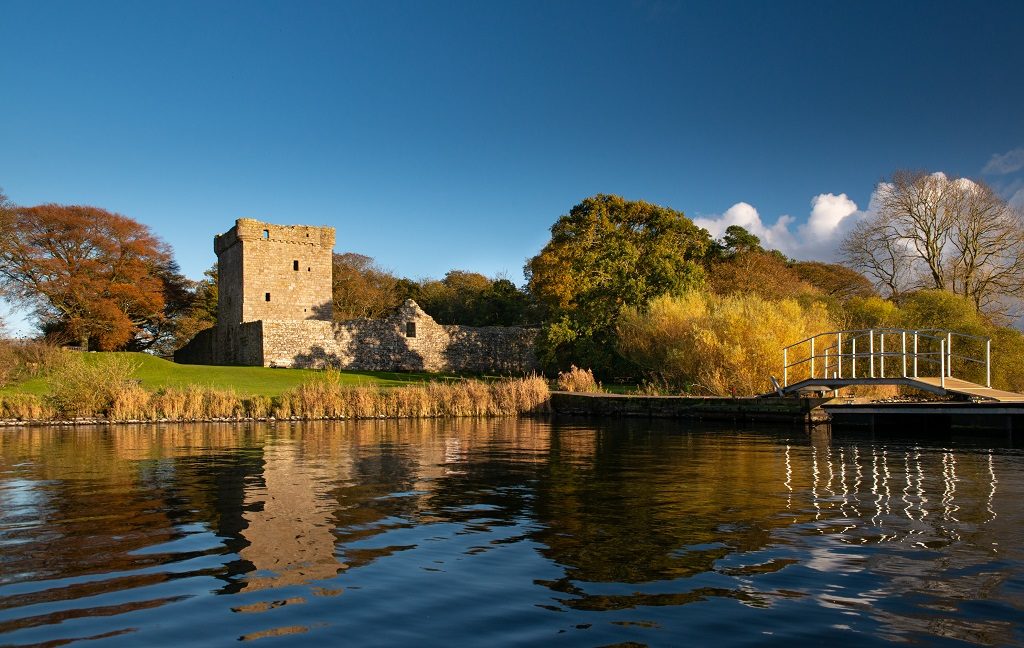
Mary spent the entire ride back to Edinburgh cursing her captors and vowing to have them killed; leading to her being humiliated and placed in confinement, not at Holyrood Palace, but was taken to Lochleven Castle on an island in the middle of a loch. The lords plan was to rule as regent of Prince James while Mary was kept imprisoned. Queen Elizabeth I, however, was shocked that reigned and anointed queen should be treated in such a manner and sent letters saying as much and threatening war onto Scotland. Mary did not know of Elizabeth’s support and was forced to sign documents stating she abdicated in favor of her son and that the Scottish Lords would act as regent to Scotland. Five days later, James was crowned King of Scotland. Fortunately, after much discussion, Mary convinced her brother, Lord Moray, a Protestant, to be James’ regent.
Loch Leven Castle, Kinross. Historic Environment Scotland.
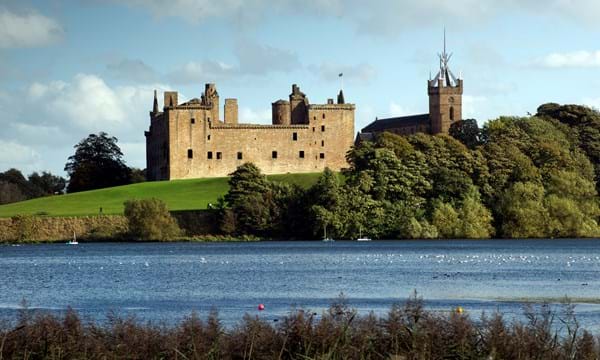
Mary eventually escaped from Lochleven Castle on May 2nd, 1568. Mary fled south to Carlisle Castle in England where she sought Elizabeth’s support in regaining her throne. Elizabeth, however, spent many months considering, and began to worry about Mary’s previous attempts at taking the English throne. Mary was moved by English authorities to Tutbury Castle, halfway between London and Scotland. Mary was kept imprisoned, in comfortable lodgings, for several years while Elizabeth considered what to do with her. In 1571, Lord Moray, Mary’s brother and King James VI’s regent was assassinated at Linlithgow Palace by a supporter of Mary. This caused Elizabeth to again consider Mary a threat to her throne and basically condemned Mary to a life of imprisonment.
In 1586, the Babington Plot to kill Queen Elizabeth I was unearthed, as two of Mary’s supporters plotted the assassination of the queen in order to put Mary back on the throne. Mary sent a letter agreeing to the murder of Elizabeth, stating, “Let the great plot commence.” This letter, among others, was given to Thomas Walsingham, one of Elizabeth’s spies; thus, signing Mary’s death warrant. Mary was transferred to Fotheringham Castle on September 25th, 1586, and was convicted of treason on October 25th, the penalty of which was death.
Mary, the former Queen of Scots, was executed on February 8th, 1587, at Fotheringham Castle. She had spent the previous night praying while she listening to her executioner’s block being constructed in the next room. Mary chose to leave the world as a Catholic martyr and wore a deep red gown to her own execution that was revealed just before her head was placed on the block. Before she was executed, Mary’s last words were “In manus tuas, Domine, commendo spiritum meum,” or “Into your hands, O Lord, I commend my spirit.” It took two strikes of the executioner’s axe to behead Mary and, thus, was the end of Mary Queen of Scots.
Bibliography
Fraser, Antonia. Mary Queen of Scots. United States: Random House Publishing Group, 2014.
Guy, John Alexander. My Heart is My Own: The Life of Mary Queen of Scots. United Kingdom: Fourth Estate, 2004.
Guy, John. Queen of Scots: The True Life of Mary Stuart. United States: Houghton Mifflin Harcourt, 2014.
Williams, Kate. The Betrayal of Mary, Queen of Scots: Elizabeth I and Her Greatest Rival. United States: Pegasus Books, 2020.
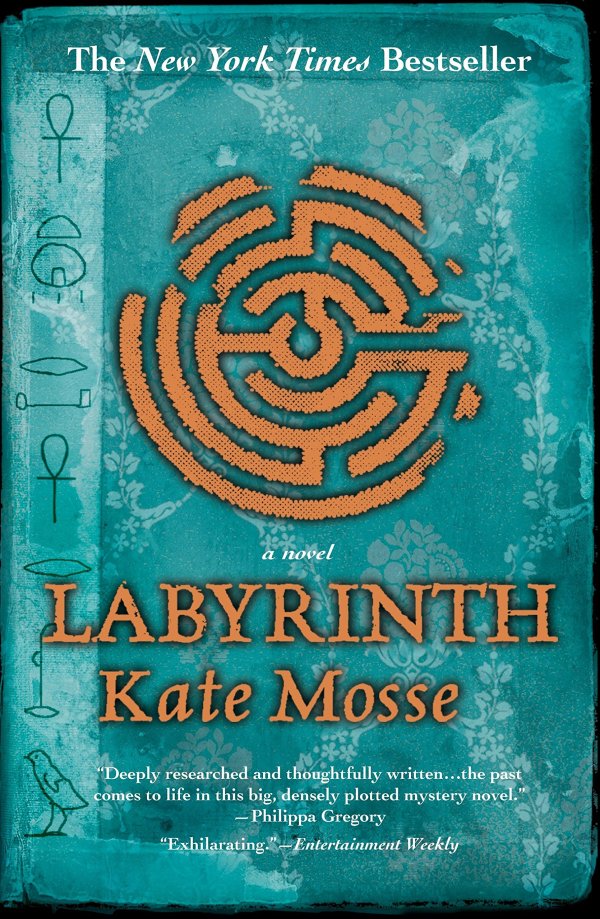
Labyrinth came out in 2005 as the first novel in the Languedoc Trilogy. The novel is set in both the the present day and in the 13th century, specifically during the Albigensian Crusade in France. Labyrinth could be called a mix of thriller and fiction, weaved together with history. The story itself focuses on the findings of an archaeological dig outside of Carcassonne, France and on the search for the Holy Grail. The story provides an interesting twist on the quest for the Holy Grail and appeals to lovers of historical fiction and mystery lovers alike.
The two heroines of the story, Alice and Alais, are tied together through time, however, I, personally, had trouble following how and why Alice became aware of the connection. While I enjoyed having both perspectives, I found that the transitions between the two heroines were slightly choppy, possibly because I set the book down for so long between reading. The love story between Alice and Will also seemed a bit contrived and sudden, as they only really saw each once throughout the book.
The conflict between the Catholic Church and the Cathar “heretics” is narrated nicely, and Mosse’s skill at easily tying the story into the political and religious battle of the Middle Ages is evident throughout the book. The description of the Noblesse and how the Eygyptian hieroglyphics tied into the history and translation of the books needed to be a bit more in depth, but also a bit more comprehensible, also possibly because of my gaps between reading.
I did enjoy the ending of the book, as I only guessed what would happen over the course of the last couple of chapters, not from the beginning as sometimes happens, even though the way the books and Holy Grail became entombed seemed an interesting way to end a novel about an archaeological dig in that same cave. Overall, I would recommend Labyrinth to fans of historical fiction and mysteries, especially those set in France.
Mary Stuart became Queen of Scotland only six days after her birth at the death of her father King James V. Mary was born at Linlithgow Palace a short distance from Edinburgh on December 8th, 1542, while her father lay dying in Falkland. Even before her birth and her father’s death, Scotland was seemingly in peril at the uncertainty of the monarchy. Henry VIII, the current King of England, sought to conquer Scotland in order to have total control of the British Isles. A victory that would help him in his quest for control of France as well. Just weeks before his death, James V had suffered a crushing loss at the Battle of Solway Moss; a loss that resulted in the captured of up to 1200 Scots as England’s prisoner, include 23 Scottish nobles and lairds. It was this loss that fractured the psyche of James V and caused him to shut himself away at in his Falkland Palace. Learning that his newborn child was a girl instead of the male heir he wished for did not help his mindset and he died locked away without having ever set eyes on his daughter.
Mary Queen of Scots’ reign was as tumultuous as her first days on Earth. Her first several years of life were spent in the care of her mother Mary de Guise at Sterling Castle in Scotland. Once she was actually crowned Queen of Scotland a little before her first birthday, Mary de Guise, after playing her political enemies against each other, renewed the Scottish alliance with France. This alliance infuriated the then English King, Henry VIII, who had long hoped to take control of both Scotland and France. He had also hoped to contract a marriage alliance between Mary and his son Edward. It was this “treachery,” as he saw it, concocted by Mary de Guise, that led him to invade Scotland, attempting to both destroy the port of Leith and take Edinburgh Castle. Instead of taking Edinburgh Castle, however, the English troops burned the city of Edinburgh, as well as other smaller outlying towns, and ransacked Holyrood Palace. Fortunately, Mary de Guise and her infant queen were heavily protected miles away at Stirling Castle.
During this time, Cardinal David Beaton had been jockeying to become the regent for Mary Queen of Scots. However, on May 29th, 1546, after he ordered the execution of a powerful Protestant preacher for heresy in a terrifying spectacle of gunpowder, Beaton was assassinated. His assassination was carried out by a group of Protestant lairds from Fife who had become unhappy with Beaton’s level of power. After sneaking into St. Andrew’s Castle, the lairds cornered Beaton in his bedroom, stabbed him to death and then hung his naked body on the castle walls for all to see. Beaton’s assassination was a major turning point for Scotland, as it signaled both a shift towards Protestantism and had a destabilizing effect on the nation.
After Henry VIII died in January and Francis I died in March of 1547, the new King of France Henry II began negotiations to betrothe the dauphin of France, Francis, to Mary Queen of Scots. By the summer of 1548, the treaty between France and Scotland was ratified and the now five year old Mary was sent to France. The young queen was made to feel at home in France and eventually became comfortable being away from both Scotland and her mother.
In 1551, after spending a year in France with her mother, Mary de Guise, touring the French countryside, an attempt was made on her life. One of the men who had attacked St. Andrews Castle at the urging of the English, and who had been imprisoned in France until his sentence was up, had joined the Garde Ecossaise to exact revenge on Scotland’s monarchy. This assassin made his way to Mary’s apartments and planned to subdue her cook so that he could poison her as she ate her favorite dessert. Luckily, the assassination plot was revealed and never came to fruition, and the would-be-assassin was tried and executed.
Several years later, King Henry II of France was killed after a jousting accident in which the lance splintered into his brain. This left the young Francis and Mary to take the throne. In 1559, Francis was named King of France and Mary was named Queen of France. She was now a queen of two countries at the young age of seventeen. However, due to her young age, the death of her mother, and the ambitions of her uncles, one of the most prominent being a bid for the English throne, Mary was more of a pawn than a queen in her own right.
Mary’s status as Queen of France lasted a little under a year and a half. Her husband, Francis, died on December 5th, 1560 from what historians have argued was either an ear infection or possibly a brain tumor. Francis’ death left Mary with no real place in France and so in 1561 she set sail for Scotland. Upon reaching Scotland, she found a country that was considered uncivilized to the life she had known in France. Mary was forced to land in Leith without her royal attire or horses and so her homecoming lacked the pomp and circumstance she had planned for as queen.
In 1563, another one of Mary’s relatives was killed; her uncle, the Duke of Guise. The duke was assassinated during the siege of Orleans, having been shot three times by a Huguenot. Mary was particularly impacted by his death as he had been her favorite uncle since childhood and had grown up under his mentorship in France. It was after the Duke of Guise’s death that Mary began to feel very much alone…
Bibliography
Fraser, Antonia. Mary Queen of Scots. United States: Random House Publishing Group, 2014.
Guy, John Alexander. My Heart is My Own: The Life of Mary Queen of Scots. United Kingdom: Fourth Estate, 2004.
Guy, John. Queen of Scots: The True Life of Mary Stuart. United States: Houghton Mifflin Harcourt, 2014.
Williams, Kate. The Betrayal of Mary, Queen of Scots: Elizabeth I and Her Greatest Rival. United States: Pegasus Books, 2020.
Welcome to Medieval Murder, the blog where you can read about medieval history topics from the early medieval period all the way to the early modern period! Most blog posts will focus on medieval murder in some way or another but all medieval topics are fair game!
All blog information will be cited as this will be a blog based on historical facts, as well as my own opinion on the subjects.
Feel free to make requests, leave comments, or just to email and say hi!
 Medieval Murder